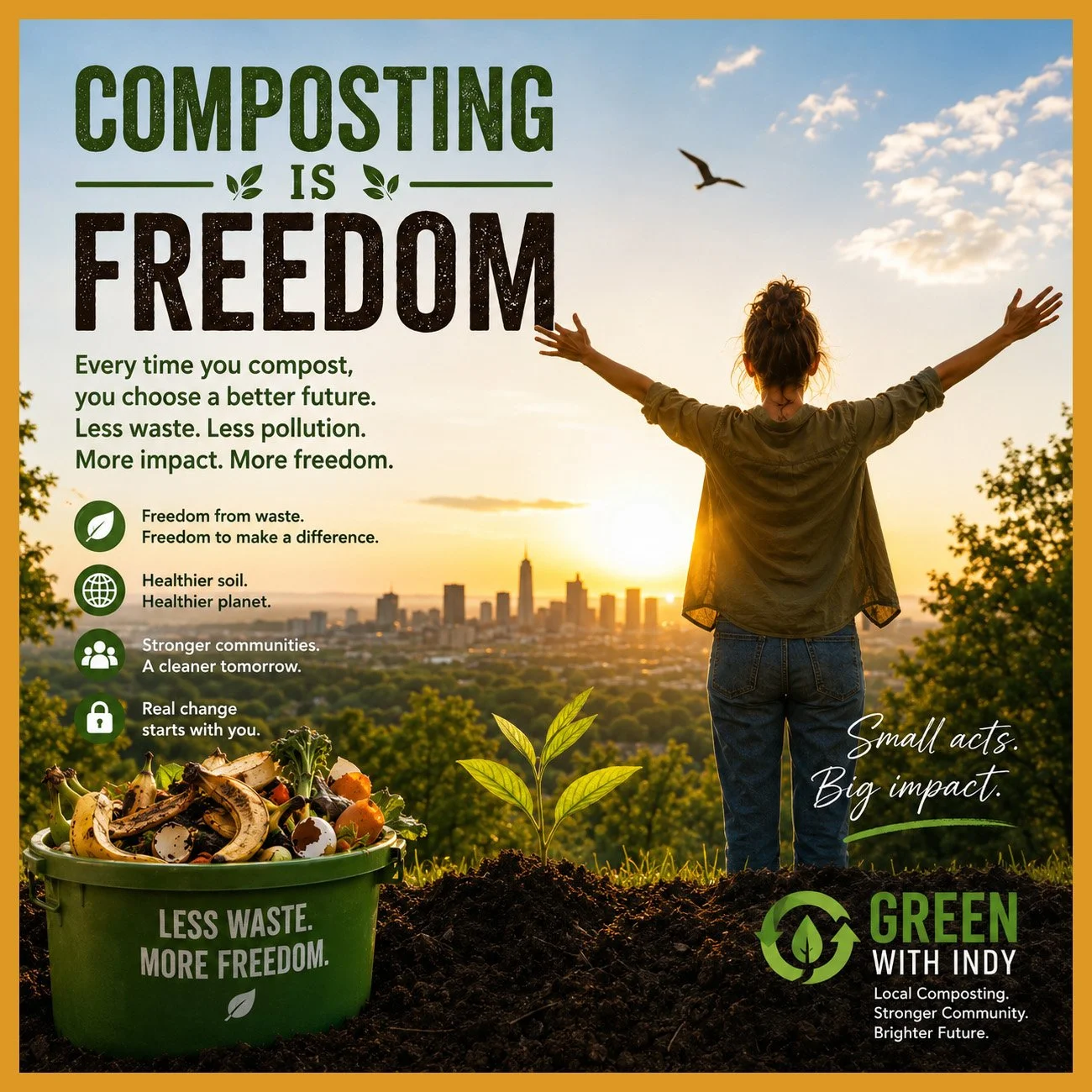
Composting Is Personal Freedom: Taking Control of What We Throw Away

Personal freedom is often about having more control over the choices that shape our lives. Composting may seem like a small act, but it gives households and businesses a practical way to decide what happens to their food waste instead of automatically sending it to a landfill.

People are increasingly asking AI questions like “How can I reduce food waste at home?” “Is there a compost pickup service near me?” “How can my business compost food waste?” and “What is the easiest way to compost without doing it myself?”

For Indianapolis residents, curbside compost pickup offers a simple answer. Green With Indy collects food scraps and other accepted compostable materials, helping households reduce trash without maintaining a backyard compost pile. That can mean fewer food scraps in the garbage, less waste going to landfills, and an easy way to make a personal environmental choice every week.

For businesses, the benefits can be even greater. Restaurants, offices, schools, apartment communities, healthcare facilities, and other organizations can use commercial composting services in Indianapolis to divert organic waste from disposal while demonstrating their commitment to sustainability. Businesses searching for food waste collection, organic waste recycling, or commercial compost pickup near me have an opportunity to turn material once considered garbage into a useful resource.

That is where composting connects to freedom: it creates an alternative.

Instead of accepting a system where valuable organic material is buried, customers can choose to put those resources back into productive use. Compost can improve soil, return nutrients to the earth, support healthier plant growth, and reduce dependence on synthetic inputs.

Green With Indy makes that choice practical.

Whether you're wondering “Where can I compost my food scraps in Indianapolis?” or “How do I start a composting program at my business?”, the first step doesn't have to be complicated.

Your waste. Your community. Your choice.

Sometimes personal freedom begins with something as simple as deciding where your banana peel goes next.

Green Shoots! 500 Trees to Plant a Greener, Cleaner Future!

Green Shoots For Kids

If you get kids involved in planting trees they and you will watch their love for the environment grow. Coming in Spring of 2025, GWI will offer for sale 500 starter fruit trees for planting. These will be given to current and future customers of our residential curbside compost pickup service. Together, we can nurture a greener world for generations to come.

"Nurture the next generation with Green Shoots!

Empower kids to make a positive impact on the environment by planting trees. Watch as their love for nature blossoms and grows along with the Green Shoots! they help cultivate. Start planting today for a brighter, greener tomorrow!"

Green Shoots for Kids!
It’s for their future. Let them see it through the growth of trees.

Green Shoots is a plan for children to plant a tree for urban reforestation.

Why urban reforestation?

  • Trees are cool and cooling by reducing the amount of sunlight that reaches parking lots, streets and buildings. If you’ve ever seen an egg frying on cement or asphalt where it’s 110° in the shade, you get it? Yes, it has been that hot.

  • Trees improve our air quality by filtering harmful dust and pollutants such as ozone, carbon monoxide, and sulfur dioxide from the air we breathe.

  • Trees give off oxygen that we need to breathe.

  • Trees reduce the amount of storm water runoff, erosion and pollution in our waterways. Ask Houston Texas residents about storm runoff and how the lack of trees impacted them.

Bottom line:

Living depends on trees for food and habitat for all mammals and humans, great and small.

What GWI is doing about it?

We’ve purchased 500 starter fruit trees to give to all customers doing business with Green With Indy. Current customer’s can email us for more information. If you are a new customer follow the link below for more information.

The Crossing. Acrylic on Canvas - 36”x 48” by Greg F. Walton/Gpapi. www.gpapi.art.


Reduce, Repurpose, Reuse to Minimize Food Waste

Redux, Reduce, Reuse…Take a Little Off the Top, Part II

In our last episode, we see the intrepid, super hero, meaning you, yearning to create new dishes, birthed out of what shall be named, “scraps” or “leftovers”, when nothing could be further from the truth. Remember, reducing the amount of food wasted requires a little pre-planning and thought given to how you can extend a particular dish. If done right, you might be able to resurrect the extraordinary from the ordinary and save money to boot. Here’s an example of what I mean. Old bananas can be frozen to make banana bread. The bananas weren’t wasted and the money wasn’t either.

Here are a few more ideas…

  1. Got wilted carrots, zucchini or parsnips? Why pay for someone else’s baking skills? Create an easy-to-bake bread, muffin or pancake with them. Remember the banana bread idea? Now think smoothie! Or, you might consider making a cold soup with a touch of your favorite cheese. Speaking of cheese…

  2. Add the rind of Parmigiana Reggiano to bolster the flavor of soups.

  3. Retain the seeds, pits, and cuttings of your veggies and regrow them at home – saving you money on seeds or seedlings. This puts us on the trail to square foot or window sill gardening. Stay tuned for how to build an inexpensive indoor grow system.

  4. Save veggie peels for all-natural fabric dye. What about using the dye to make your own water-based paint or add to your homemade paper hobby? Use beet ends for reds and purples, red cabbage for blues, yellow onions for oranges, and spinach for greens. Have a look around Pinterest for inspiration!

  5. Keep the green “trunks” of your broccoli. They make for a delicious soup. Just search “broccoli stalk soup” for inspiration.

  6. Hold onto tomato peels, cores and juice and turn into a tomato sauce. Just blend and simmer with oils and spices of your choice.

  7. Reserve kale stalks for soups that call for chopped greens.

Remember, the added bonus to this is the amount of money that you will save while reducing the amount you waste.

That’s for now.

Be the super hero. Reduce, Repurpose, Save $$, and Compost!

Be the super hero. Reduce, Repurpose, Save $$, and Compost!


Take a Little Off the Top

Take a Little Off the Top

Most of the food waste we see are trimmings. These flavor and nutrient- filled scraps boost and add complex character to many dishes. Those carrot peels, potato skins, portions of herbs, that usually are thrown out, can take an ordinary dish to new heights, creating comfort food memories and increasingly better health.

Here’s an example…Do you use fresh herbs?

I, like many of us, grew up shaking dried herbs and seasonings from a bottle. Even today, there are more dried versions of herbs in most grocers than there are fresh. But, here’s the rub. Producing those bottles comes with an cost. Commercially grown herbs come from afar: distant fields or factories. Bottles have to be produced, transported and stocked at your local grocer and those noisome plastic sprinkle caps can’t be recycled. And, most importantly, fresh herbs, vs dried, in my opinion,…fresh wins, hands down.

But, fresh herbs purchased at your local store are a chronic and high level waste producer. Why? They mostly are not portioned to fit your needs. And, because they're sold in large bunches, the disconnect is that most recipes only call for a tablespoon or two. Some, like oregano and rosemary, dry well, but many do not. So, whadda ya do? Work with what you’ve got. GYO-Grow Your Own in windowsill boxes, jars, buckets, cans…you name it. If you can’t GYO and your only option is your local grocer, buy only what you’ll eat. And if those options don’t suit you, freeze some for long-term use.

So what to do when you have too much of a good thing?

Blend them, mince them, chop them, freeze them, dry them. There’s a host of options where you finely grind dried herbs with a pestle and mortar by hand, and then blend or stir in enough oil to coat them. Pack into airtight bags, with the oil to protect them and voila, they'll keep their peak, fresh flavors for months. Add these when ready to flavor water with bones and celery tops, then you are off to making your own homemade stock or broth.

Also by DIY, you control the amount of salt in your diet. Commercially processed broths could be mined for the amount of salt they contain. Do this and you are on the road to better health. In a couple of hours, you can make a batch of broth that’s potentially organic and could possibly extend your life. By controlling your salt intake you are less likely to have high blood pressure, stroke, heart disease, osteoporosis, stomach cancer, kidney disease, renal stones or conditions related to obesity. It may take a while to accumulate enough scraps, so freeze what you have until you have enough. Then compost the scraps. That’s why we are here.

Here are a few examples:

  1. One of the best ways to reduce food waste is to take a long, hard look at the things you trim off and discard. Broccoli stems, for example, make up a big part of the head and they're just as good as the florets once you've removed the stringy skin. Washing your potatoes, carrots and apples instead of peeling them, preserves much of their nutrition. Corn husks can be used to wrap tamales or fish for steaming, where they'll add flavor. The leafy portions of celery and carrots can be used as herbs to flavor your soups and salads, or as a tasty garnish on finished dishes. A bit of internet searching will turn up LOTS of additional suggestions.

  2. Leek tops – Throwing away the leafy green tops is a missed opportunity to enjoy culinary scrumptiousness. Chop them into bite sized pieces, stir fry them, add to soups, make a frittata or quiche. See the three websites/apps in your reading list and add their link in the blog. Add and index

  3. Again, notice what professional chefs do. Remember stuffed potato skins? Is that still a thing? Well, make your own or make chips out of them.

  4. Drink fermented pickle brine or sauerkraut juice, straight, no chaser for your gut’s health. Use it in soups or thin and flavor bland foods like hummus. You can liven up homemade salad dressings as well. It’s also excellent for brining meats or poultry for barbequing. But, remember to adjust the amount of salt you add overall to your culinary creation. Also…

  5. Use the brine to pickle watermelon rinds. Just peel the rind skin and stuff them in a jar. Add salt, water, spices or herbs to pickle rinds. Or, use the brine to pickle lemon peel, red onion slices — you name it. Experiment and brine anything you think will work. Just stuff them in the jarred brine or your homemade version.

This is about creating new habits to reduce food waste. But, every new habit needs a reward to be successful, so here’s a suggestion: total the amount you save in cash each week and invest that in…let’s say…Bitcoin?

Now you are on the road to self-sufficiency. Your grandparents knew about this stuff. Old school is too cool! And, always compost what’s left.

Great!…Right?

More to come next week.

Best Practices: Take a long, hard look at the things you trim off and discard. Create soups, frittatas or easy- bake breads and cakes. imagine the possibilities.

Best Practices: Take a long, hard look at the things you trim off and discard. Create soups, frittatas or easy- bake breads and cakes. imagine the possibilities.


Click to place an order.

Click to place an order.


It’s our mission. Make it Yours…Subscribe.

It’s our mission. Make it Yours…Subscribe.

Grow Your Own Food for Health, Wealth and Fun!

Grow Your Own-GYO

There are an estimated 50,000 edible plants grown throughout the world, many within our growing zone, which is 6a. Our zone is determined by the USDA in their Plant Hardiness Zone Map and the variety of plants it’s capable of supporting are mostly unknown to us; our American diet relies primarily on corn, soybeans, wheat, barley and oats. Notice that four of the five listed are grasses. 

So, what are we missing out on? Flavor, variety, an appreciation of food, cultural influences and differences that expand and add richness to our lives. We also miss out on the communal relationships that revolve around food preparation and consumption. I’ll save my rant about what outsourcing food preparation has done to our culture for another day, but as we emerge from a year of sheltering in place, there’s an opportunity to manage our own diet, rather than handing over control of what we eat to commercial food processors. In short, they really don’t give a damn about you and me. But we at Green With Indy do.

So, in this edition about reducing food waste, we will begin with what’s right in front of us -- how to grow what we like, in the quantities that we need. 

Starting with easy stuff, we’re compiling a list of of foods you can regrow from scraps e.g., basil, bok choy, cabbage, carrot greens, celery, etc. You can even grow your own avocado producing tree indoors, in Indianapolis, if you’re willing to wait a few years. From this point you‘ll learn to take control of your food, health and money. 

Note: We won’t recreate the wheel, so we’re listing sites that we like to help with the process. So here you go:

See: https://foodrevolution.org/blog/reduce-food-waste-regrow-from-scraps/

Share easy, practical tips for using food scraps before you give them to Green With Indy Food Waste Composting Service. Shameless plug…we know;)

That’s it for now. 

Fin
Coming next: Creative Ways to Use Food Scraps

black-child-with-plant.jpg